

Never Again
.
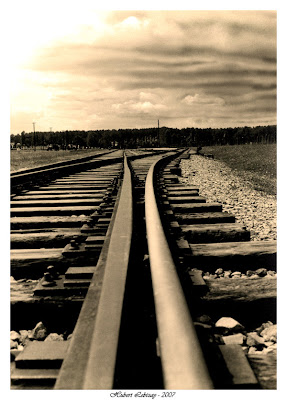 © 2008 - Hubert Lebizay
.
Auschwitz
.
By Taher Shemaly
By the coldness of the snows
that doesn't stop blowing
Stood there a group of fellows
they said they're mourning
Gathered from all the nations
and yelled so high for something
They say Auschwitz is the name
so hard in the heart it feels
Auschwitz the hard one to blame
the one of unexpected deals
Walk by O passer by in manner the same
might a tear of you falls and heals
Oh Birkenau how many did cry
to keep those devilish smiles
Oh Auschwitz how many did go by
talking to your bricks and tiles
Ashamed? or your sounds were cut off?
but to the graves I sat away from guiles
It is not about Christian or Jew
or a Muslim or pagan made so new
My friend it is a story of a human
dispaired of a different hue
Keep in your mind old Auschwitz
or another Auschwitz will be made so new
And I wish with my words so humble
that the Man will understand in his rumble
It is a story of sorrow and happiness
not what he or she believes for a bundle
Dear human, you made me despaired
what could be there after the Nazis, a mangle?
(Poem's source : poemsabout.com)
***********************
/http%3A%2F%2Fbp2.blogger.com%2F_KMJlfU5vYb4%2FR6KCqPR2EtI%2FAAAAAAAACK0%2F9aIKDHP8Qp8%2Fs400%2FEnd%2BThe%2BSiege%2B%28Ben%2BHeine%29.jpg) © 2008 - Ben Heine
© 2008 - Ben Heine
.
The State of Gaza
Should Shame Us All
.
By Barbara Stocking
Director of Oxfam
.
On the day last week that thousands of Gazans began streaming across the breached border with Egypt, looking for food, medicine and a taste of freedom, one of Oxfam's staff in Gaza told us that his children are now too frightened to sleep anywhere except in their parents' bed. They are six and two, and desperately confused, he said.
"What they understand the least," he went on to explain, "is why their lives are being affected by something which they are not responsible for. " 'Why us? Why are we cold? What is happening?' I explain to them that it is because of the blockade and the fuel and electricity cuts, but still they ask 'Why us?'"
After seven months of siege, it is a good question. And there are others: how have we allowed this situation to develop? Why are the children of Sderot also unable to sleep for fear of rocket attacks from Palestinian militants? With all the international community's avowals of action to move the peace process forward, its hand-wringing and protests over the illegal blockade of Gaza, why do we now have this unmovable stalemate? For the 1.5 million people of Gaza, many of whom last week ran out of flour and fuel, who have sewage running in their streets, whose children are hiding in their parents' beds, our politicking and procrastination must look futile.
I was in the Gaza Strip a few weeks ago - it is a place of many absurdities. A refugee camp now for three generations, it should feel like a dump for unwanted humanity: but everywhere you go you are impressed by the resilience of people, their deep desire to get on and lead better lives. The world's largest prison, Gaza is often called - but that understates it. At least in a prison, people know more or less how long they are going to be there. Gaza is the world capital of uncertainty, of lives unfulfilled. So much suffering for so many in such a confined space is literally unbearable.
The statistics are stark: 55 per cent unemployment with 70,000 jobs lost since June; 80 per cent of the population dependent on food aid; one in ten children's growth stunted by hunger. The fact of the blockade, illegal and inhumane as it is, makes me angry enough. But I am more incensed by the abject failure of the governments with influence over actors in the region to find a solution to this impasse.
We - and by this I mean all of us who have influence in the democracies of the rich world - must accept our share of the shame for that failure. While we have invested our hopes in the promise of a renewed peace process, which began at Annapolis, this has allowed us to turn from the realities of the suffering of Gaza, allowed us to take our eyes off the ball. A diplomat the other day assured us that her masters had decided that, "By working out the politics and the peace we'll find the way to tackle the humanitarian issue".
How heartless that is. And how unwise. The sufferings of the abused and displaced have always made solutions more difficult, not easier: the history of the Middle East will tell anyone that. The angry, the disenfranchised and the destitute cannot make good interlocutors at a peace conference - or good neighbours in the future. Bullying a people to the conference table makes for bad peace. What the diplomats at Annapolis have lost sight of is that striving for peace must go hand in hand with addressing the humanitarian situation in Gaza.
The reaction to last week's events was particularly shameful, with arguments in the international arena over whether cutting off all supplies to 1.5 million already impoverished people was collective punishment or not. Israel reacted swiftly to calls to ease the total blockade by easing it fractionally: diplomats nodded and turned their attention away from the problem, yet again. International commentators saw the rush through the broken wall at Rafah into Egypt in the terms of a shopping frenzy, a vivid illustration of the power of market forces in extremis. What it was, in fact, was yet more proof of the intolerable pressure inside Gaza - an eruption of people "offered a day out of jail", as many papers put it. Newsweek called it "a PR war". Again, the view of Oxfam's colleagues in Gaza was more down-to-earth - after last week's events, one who runs a women's crisis centre told us that she felt like someone whose torturers have been holding his head under water. "They pulled the head out - but he can still see the water. The story is not over."
How do we move this forward? While accepting the legitimate security concerns of Israel, we must be clear that the plight of the people of Sderot, facing a daily barrage of rockets from Gaza will not end, unless Israel too stops its blockade and military attacks. Improving the lives of ordinary people must be at the heart of the peace process - and we call for all sides, Palestinian and Israeli, to do their utmost to ensure the people of Gaza and of Israel's needs are met and their rights respected.
The time has come to ask serious questions about this peace process and the strategy behind it. Do the authors of it - in the current revised edition - want the same peace that the rest of the international community wants? Why - despite growing insistence from all shades of public opinion - won't the official peace makers, including Tony Blair, state publicly that a meaningful peace must ultimately involve all Palestinian parties, including Hamas? The US administration and the EU must take a share of the responsibility for the split that divided the Palestinians into opposed political groups: they should in turn encourage Israel to talk to both sides.
Because that is the key to it . As has been said before, you make peace with your enemies and modern history has many stories of intractable problems whose resolution began when two sides that had sworn never to sit down together sat down together. The opening of talks between the ANC and the white regime in South Africa is one inspiring example. In the 1980s a British Prime Minister refused ever to talk to the terrorists in Northern Ireland; a few years later her colleague and successor decided to open discussions with the IRA. Tony Blair was able to harvest and bring home the deal that emerged from that.
So, let's talk about Gaza, and the West Bank with all the actors. There are moderate elements in Hamas, as in every nationalist movement - we cannot foster them by isolating them. Hamas also have clear responsibilities for the safety of ordinary Gazans which should be recognised if we want to make progress. Otherwise, the horror in Gaza, can only go in one direction - and that, in some form or other, will sadly in all likelihood only lead to more bloodshed. And we must fear that there are those, internationally and in the region, who appear to want exactly that outcome.
Meanwhile, extraordinarily, life goes on in Gaza. The determination of the Gazans to live as well as they can amazed and inspired my brief visit. One staff member has a plan to import solar powered ovens, as a way past the fuel shortages. There's a scheme to breed rabbits for food. But the other dark stories are there - the rise in domestic violence, because of frustration and fear. The drug abuse. The children whose lives are so disrupted that, we're told by our partners, 70 per cent are not performing properly at school. All of them, I imagine, are asking "Why us?" We must now answer them honestly and give them some hope for the future.
--------------------
--> The article appeared on www.telegraph.co.uk
--> Also visit this website : www.end-gaza-siege.ps : "We are a diverse group of civil society activists, human rights activists, intellectuals, academics, businessmen from Gaza and the West Bank, united by our commitment to peace, human dignity and human rights, and guided by our ethical and moral responsibilities to help our people who suffers the hardest conditions."
GAZA is on the threshold of becoming the first territory to be intentionally reduced to a state of abject destitution, with the knowledge, acquiescence and - some would say - encouragement of the international community. An international community that professes to uphold the inherent dignity of every human being must not allow this to happen.
Across this tiny territory, 25 miles long and no more than six miles wide, a deep darkness descended at 8 pm on January 21, as the lights went out for each of its 1.5 million Palestinian residents. A new hallmark of Palestinian suffering had been reached.
There have been three turns of the screw on the people of Gaza, triggered in turn by the outcome of the elections in January 2006, the assumption by Hamas of de facto control last June, and the Israeli decision in September to declare Gaza a "hostile territory". Each instance has prompted ever tighter restrictions on the movement of people and goods in and out of Gaza. Each turn of the screw inflicts deeper indignity on ordinary Palestinians, breeding more resentment towards the outside world.
Gaza's border closures are without precedent. Palestinians are effectively incarcerated. The overwhelming majority cannot leave or enter Gaza. Without fuel and spare parts, public health conditions are declining steeply as water and sanitation services struggle to function. The electricity supply is sporadic and has been reduced further along with fuel supply in these past days. Unicef reports that the partial functioning of Gaza City's main pumping station is affecting the supply of safe water to some 600,000 Palestinians.
Medication is in short supply, and hospitals are paralysed by power failures and the shortage of fuel for generators. Hospital infrastructure and essential pieces of equipment are breaking down at an alarming rate, with limited possibility of repair or maintenance as spare parts are not available.
It is distressing to see the impact of closures on patients who need to travel outside Gaza to get medical treatment. The demand for such treatment is rising as medical standards fall inside Gaza, yet the permit regime for medical referrals has become more stringent. Many have had their treatment delayed or denied, worsening their medical conditions and causing preventable deaths.
Living standards in Gaza are at levels unacceptable to a world that promotes the elimination of poverty and the observance of human rights as core principles: 35 per cent of Gazans live on less than two dollars a day; unemployment stands at around 50 per cent; and 80 per cent of Gazans receive some form of humanitarian assistance. Concrete is in such short supply that people are unable to make graves for their dead. Hospitals are handing out sheets as funeral shrouds.
As the head of a humanitarian and human development agency for Palestinian refugees, I am deeply concerned by the stark inhumanity of Gaza's closure. I am disturbed by the seeming indifference of much of the world as hundreds and thousands of Palestinians are harshly penalised for acts in which they have no part.
In discharging its mandate, UN Relief and Works Agency delivers a variety of services to improve living conditions and prospects for self-reliance. It is impossible to sustain our operations when the occupying power adopts an "on, off", "here today, gone tomorrow" policy towards Gaza's borders. To take one example, this week we were on the verge of suspending our food distribution programme. The reason was seemingly mundane: plastic bags. Israel blocked entry into Gaza of the plastic bags in which we package our food rations.
In today's Gaza how can we foster a spirit of moderation and compromise among Palestinians, or cultivate a belief in the peaceful resolution of disputes? There are already indications that the severity of the closure is playing into the hands of those who have no desire for peace. We ignore this risk at our peril.
What we should be doing now is nurturing moderation and empowering those who believe that Gaza's rightful future lies in peaceful co-existence with its neighbours. We welcome the new efforts to resuscitate the peace process, revive the Palestinian economy and build institutions. These pillars, on which a solution will be built, are the very ones being eroded.
The people of Gaza recently received a temporary reprieve when the occupying power allowed fuel and other supplies to enter: 2.2m litres of fuel per week for the Gaza power plant and 0.5m litres a week for industrial usage, hospitals and clinics. We have been informed that the crossings into Gaza will be partially open, allowing UNRWA and other organisations to bring in about 50 trucks a day. No one knows how long the reprieve will last as the resumption of Qassam rocket fire, which we ourselves strongly condemn, will lead to further closures.
The people of Gaza have been spared from reaching new depths of anguish - but only for the moment. There has never been a more urgent need for the international community to act to restore normality in Gaza. Hungry, unhealthy, angry communities do not make good partners for peace.
------------------
(*) Karen Koning AbuZayd is Commissioner General for UN Relief and Works Agency for Palestine Refugees in the Near East (UNRWA)
 © 2008 - Hubert Lebizay
.
Auschwitz
.
By Taher Shemaly
By the coldness of the snows
that doesn't stop blowing
Stood there a group of fellows
they said they're mourning
Gathered from all the nations
and yelled so high for something
They say Auschwitz is the name
so hard in the heart it feels
Auschwitz the hard one to blame
the one of unexpected deals
Walk by O passer by in manner the same
might a tear of you falls and heals
Oh Birkenau how many did cry
to keep those devilish smiles
Oh Auschwitz how many did go by
talking to your bricks and tiles
Ashamed? or your sounds were cut off?
but to the graves I sat away from guiles
It is not about Christian or Jew
or a Muslim or pagan made so new
My friend it is a story of a human
dispaired of a different hue
Keep in your mind old Auschwitz
or another Auschwitz will be made so new
And I wish with my words so humble
that the Man will understand in his rumble
It is a story of sorrow and happiness
not what he or she believes for a bundle
Dear human, you made me despaired
what could be there after the Nazis, a mangle?
(Poem's source : poemsabout.com)
***********************
End the Siege
on Gaza
on Gaza
.
 © 2008 - Ben Heine
.
The State of Gaza
Should Shame Us All
.
By Barbara Stocking
Director of Oxfam
.
On the day last week that thousands of Gazans began streaming across the breached border with Egypt, looking for food, medicine and a taste of freedom, one of Oxfam's staff in Gaza told us that his children are now too frightened to sleep anywhere except in their parents' bed. They are six and two, and desperately confused, he said.
"What they understand the least," he went on to explain, "is why their lives are being affected by something which they are not responsible for. " 'Why us? Why are we cold? What is happening?' I explain to them that it is because of the blockade and the fuel and electricity cuts, but still they ask 'Why us?'"
After seven months of siege, it is a good question. And there are others: how have we allowed this situation to develop? Why are the children of Sderot also unable to sleep for fear of rocket attacks from Palestinian militants? With all the international community's avowals of action to move the peace process forward, its hand-wringing and protests over the illegal blockade of Gaza, why do we now have this unmovable stalemate? For the 1.5 million people of Gaza, many of whom last week ran out of flour and fuel, who have sewage running in their streets, whose children are hiding in their parents' beds, our politicking and procrastination must look futile.
I was in the Gaza Strip a few weeks ago - it is a place of many absurdities. A refugee camp now for three generations, it should feel like a dump for unwanted humanity: but everywhere you go you are impressed by the resilience of people, their deep desire to get on and lead better lives. The world's largest prison, Gaza is often called - but that understates it. At least in a prison, people know more or less how long they are going to be there. Gaza is the world capital of uncertainty, of lives unfulfilled. So much suffering for so many in such a confined space is literally unbearable.
The statistics are stark: 55 per cent unemployment with 70,000 jobs lost since June; 80 per cent of the population dependent on food aid; one in ten children's growth stunted by hunger. The fact of the blockade, illegal and inhumane as it is, makes me angry enough. But I am more incensed by the abject failure of the governments with influence over actors in the region to find a solution to this impasse.
We - and by this I mean all of us who have influence in the democracies of the rich world - must accept our share of the shame for that failure. While we have invested our hopes in the promise of a renewed peace process, which began at Annapolis, this has allowed us to turn from the realities of the suffering of Gaza, allowed us to take our eyes off the ball. A diplomat the other day assured us that her masters had decided that, "By working out the politics and the peace we'll find the way to tackle the humanitarian issue".
How heartless that is. And how unwise. The sufferings of the abused and displaced have always made solutions more difficult, not easier: the history of the Middle East will tell anyone that. The angry, the disenfranchised and the destitute cannot make good interlocutors at a peace conference - or good neighbours in the future. Bullying a people to the conference table makes for bad peace. What the diplomats at Annapolis have lost sight of is that striving for peace must go hand in hand with addressing the humanitarian situation in Gaza.
The reaction to last week's events was particularly shameful, with arguments in the international arena over whether cutting off all supplies to 1.5 million already impoverished people was collective punishment or not. Israel reacted swiftly to calls to ease the total blockade by easing it fractionally: diplomats nodded and turned their attention away from the problem, yet again. International commentators saw the rush through the broken wall at Rafah into Egypt in the terms of a shopping frenzy, a vivid illustration of the power of market forces in extremis. What it was, in fact, was yet more proof of the intolerable pressure inside Gaza - an eruption of people "offered a day out of jail", as many papers put it. Newsweek called it "a PR war". Again, the view of Oxfam's colleagues in Gaza was more down-to-earth - after last week's events, one who runs a women's crisis centre told us that she felt like someone whose torturers have been holding his head under water. "They pulled the head out - but he can still see the water. The story is not over."
How do we move this forward? While accepting the legitimate security concerns of Israel, we must be clear that the plight of the people of Sderot, facing a daily barrage of rockets from Gaza will not end, unless Israel too stops its blockade and military attacks. Improving the lives of ordinary people must be at the heart of the peace process - and we call for all sides, Palestinian and Israeli, to do their utmost to ensure the people of Gaza and of Israel's needs are met and their rights respected.
The time has come to ask serious questions about this peace process and the strategy behind it. Do the authors of it - in the current revised edition - want the same peace that the rest of the international community wants? Why - despite growing insistence from all shades of public opinion - won't the official peace makers, including Tony Blair, state publicly that a meaningful peace must ultimately involve all Palestinian parties, including Hamas? The US administration and the EU must take a share of the responsibility for the split that divided the Palestinians into opposed political groups: they should in turn encourage Israel to talk to both sides.
Because that is the key to it . As has been said before, you make peace with your enemies and modern history has many stories of intractable problems whose resolution began when two sides that had sworn never to sit down together sat down together. The opening of talks between the ANC and the white regime in South Africa is one inspiring example. In the 1980s a British Prime Minister refused ever to talk to the terrorists in Northern Ireland; a few years later her colleague and successor decided to open discussions with the IRA. Tony Blair was able to harvest and bring home the deal that emerged from that.
So, let's talk about Gaza, and the West Bank with all the actors. There are moderate elements in Hamas, as in every nationalist movement - we cannot foster them by isolating them. Hamas also have clear responsibilities for the safety of ordinary Gazans which should be recognised if we want to make progress. Otherwise, the horror in Gaza, can only go in one direction - and that, in some form or other, will sadly in all likelihood only lead to more bloodshed. And we must fear that there are those, internationally and in the region, who appear to want exactly that outcome.
Meanwhile, extraordinarily, life goes on in Gaza. The determination of the Gazans to live as well as they can amazed and inspired my brief visit. One staff member has a plan to import solar powered ovens, as a way past the fuel shortages. There's a scheme to breed rabbits for food. But the other dark stories are there - the rise in domestic violence, because of frustration and fear. The drug abuse. The children whose lives are so disrupted that, we're told by our partners, 70 per cent are not performing properly at school. All of them, I imagine, are asking "Why us?" We must now answer them honestly and give them some hope for the future.
--------------------
--> The article appeared on www.telegraph.co.uk
--> Also visit this website : www.end-gaza-siege.ps : "We are a diverse group of civil society activists, human rights activists, intellectuals, academics, businessmen from Gaza and the West Bank, united by our commitment to peace, human dignity and human rights, and guided by our ethical and moral responsibilities to help our people who suffers the hardest conditions."
.

.
Give Palestinians a Chance
to Breathe Free!
.
By Karen Koning Abuzayd (*)
Give Palestinians a Chance
to Breathe Free!
.
By Karen Koning Abuzayd (*)
GAZA is on the threshold of becoming the first territory to be intentionally reduced to a state of abject destitution, with the knowledge, acquiescence and - some would say - encouragement of the international community. An international community that professes to uphold the inherent dignity of every human being must not allow this to happen.
Across this tiny territory, 25 miles long and no more than six miles wide, a deep darkness descended at 8 pm on January 21, as the lights went out for each of its 1.5 million Palestinian residents. A new hallmark of Palestinian suffering had been reached.
There have been three turns of the screw on the people of Gaza, triggered in turn by the outcome of the elections in January 2006, the assumption by Hamas of de facto control last June, and the Israeli decision in September to declare Gaza a "hostile territory". Each instance has prompted ever tighter restrictions on the movement of people and goods in and out of Gaza. Each turn of the screw inflicts deeper indignity on ordinary Palestinians, breeding more resentment towards the outside world.
Gaza's border closures are without precedent. Palestinians are effectively incarcerated. The overwhelming majority cannot leave or enter Gaza. Without fuel and spare parts, public health conditions are declining steeply as water and sanitation services struggle to function. The electricity supply is sporadic and has been reduced further along with fuel supply in these past days. Unicef reports that the partial functioning of Gaza City's main pumping station is affecting the supply of safe water to some 600,000 Palestinians.
Medication is in short supply, and hospitals are paralysed by power failures and the shortage of fuel for generators. Hospital infrastructure and essential pieces of equipment are breaking down at an alarming rate, with limited possibility of repair or maintenance as spare parts are not available.
It is distressing to see the impact of closures on patients who need to travel outside Gaza to get medical treatment. The demand for such treatment is rising as medical standards fall inside Gaza, yet the permit regime for medical referrals has become more stringent. Many have had their treatment delayed or denied, worsening their medical conditions and causing preventable deaths.
Living standards in Gaza are at levels unacceptable to a world that promotes the elimination of poverty and the observance of human rights as core principles: 35 per cent of Gazans live on less than two dollars a day; unemployment stands at around 50 per cent; and 80 per cent of Gazans receive some form of humanitarian assistance. Concrete is in such short supply that people are unable to make graves for their dead. Hospitals are handing out sheets as funeral shrouds.
As the head of a humanitarian and human development agency for Palestinian refugees, I am deeply concerned by the stark inhumanity of Gaza's closure. I am disturbed by the seeming indifference of much of the world as hundreds and thousands of Palestinians are harshly penalised for acts in which they have no part.
In discharging its mandate, UN Relief and Works Agency delivers a variety of services to improve living conditions and prospects for self-reliance. It is impossible to sustain our operations when the occupying power adopts an "on, off", "here today, gone tomorrow" policy towards Gaza's borders. To take one example, this week we were on the verge of suspending our food distribution programme. The reason was seemingly mundane: plastic bags. Israel blocked entry into Gaza of the plastic bags in which we package our food rations.
In today's Gaza how can we foster a spirit of moderation and compromise among Palestinians, or cultivate a belief in the peaceful resolution of disputes? There are already indications that the severity of the closure is playing into the hands of those who have no desire for peace. We ignore this risk at our peril.
What we should be doing now is nurturing moderation and empowering those who believe that Gaza's rightful future lies in peaceful co-existence with its neighbours. We welcome the new efforts to resuscitate the peace process, revive the Palestinian economy and build institutions. These pillars, on which a solution will be built, are the very ones being eroded.
The people of Gaza recently received a temporary reprieve when the occupying power allowed fuel and other supplies to enter: 2.2m litres of fuel per week for the Gaza power plant and 0.5m litres a week for industrial usage, hospitals and clinics. We have been informed that the crossings into Gaza will be partially open, allowing UNRWA and other organisations to bring in about 50 trucks a day. No one knows how long the reprieve will last as the resumption of Qassam rocket fire, which we ourselves strongly condemn, will lead to further closures.
The people of Gaza have been spared from reaching new depths of anguish - but only for the moment. There has never been a more urgent need for the international community to act to restore normality in Gaza. Hungry, unhealthy, angry communities do not make good partners for peace.
------------------
(*) Karen Koning AbuZayd is Commissioner General for UN Relief and Works Agency for Palestine Refugees in the Near East (UNRWA)


/image%2F0557890%2F20140830%2Fob_0c10cb_tunisie.jpg)
/https%3A%2F%2Fassets.over-blog.com%2Ft%2Fcedistic%2Fcamera.png)